‘Cyprus Police Emergency Response Unit’ Virus
Posted: August 9, 2013
Threat Metric
The following fields listed on the Threat Meter containing a specific value, are explained in detail below:
Threat Level: The threat level scale goes from 1 to 10 where 10 is the highest level of severity and 1 is the lowest level of severity. Each specific level is relative to the threat's consistent assessed behaviors collected from SpyHunter's risk assessment model.
Detection Count: The collective number of confirmed and suspected cases of a particular malware threat. The detection count is calculated from infected PCs retrieved from diagnostic and scan log reports generated by SpyHunter.
Volume Count: Similar to the detection count, the Volume Count is specifically based on the number of confirmed and suspected threats infecting systems on a daily basis. High volume counts usually represent a popular threat but may or may not have infected a large number of systems. High detection count threats could lay dormant and have a low volume count. Criteria for Volume Count is relative to a daily detection count.
Trend Path: The Trend Path, utilizing an up arrow, down arrow or equal symbol, represents the level of recent movement of a particular threat. Up arrows represent an increase, down arrows represent a decline and the equal symbol represent no change to a threat's recent movement.
% Impact (Last 7 Days): This demonstrates a 7-day period change in the frequency of a malware threat infecting PCs. The percentage impact correlates directly to the current Trend Path to determine a rise or decline in the percentage.
| Threat Level: | 2/10 |
|---|---|
| Infected PCs: | 9 |
| First Seen: | August 9, 2013 |
|---|---|
| OS(es) Affected: | Windows |
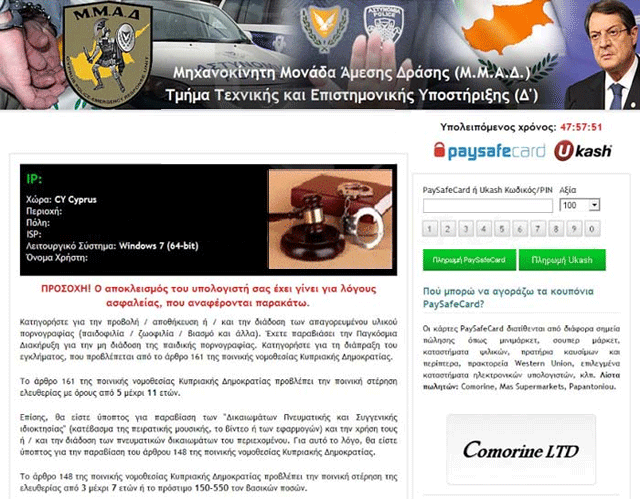 One of the most recent examples of criminals shamelessly pillaging an already-pillaged nation, the 'Cyprus Police Emergency Response Unit' Virus is a new variant of an ongoing series of Police Ransomware Trojans with attacks that have been reconfigured to target residents of Cyprus. Despite that the nation’s current headline-grabbing financial woes, the 'Cyprus Police Emergency Response Unit' Virus continues in the stereotypical attacks of its kin by accusing random PC users of committing online crimes and demanding that they pay money or face other problems besides a locked computer. SpywareRemove.com malware experts stress that the 'Cyprus Police Emergency Response Unit' Virus is not a real police-authorized program and does not need to be paid. As long as you have access to basic security features and software that are suitable for combating malicious software, you can disable and then remove the 'Cyprus Police Emergency Response Unit' Virus without needing to give in to its ransom.
The 'Cyprus Police Emergency Response Unit' Virus: Plundering the Poor without Any Qualms
The 'Cyprus Police Emergency Response Unit' Virus merely is a Cypriot clone of past fake Police Trojans from the same family, each of which specialize in a particular nation. While the 'Cyprus Police Emergency Response Unit' Virus's warning message makes references to Cyprus's police force and largely is translated into Greek, it is identical to the same fake pop-ups of other fake Police Trojans in all other details. The 'Cyprus Police Emergency Response Unit' Virus ensures that this pop-up warning is displays whenever Windows starts and also uses it to block you from accessing the rest of Windows – a state of affairs that SpywareRemove.com malware experts warn is a distinct PC security hazard.
The 'Cyprus Police Emergency Response Unit' Virus justifies its Windows-locking attacks by claiming that your computer has been involved in illegal acts (copyright law and underage pornography both are referenced for this purpose) and demands that you pay a ransom fee to get your computer back. However, the 'Cyprus Police Emergency Response Unit' Virus doesn't detect such crimes in the first place and does not have the authority of the Cypriot police to conduct its attacks, leading to the obvious conclusion that paying this ransom isn't legally required and will not help your PC.
Effectively Responding to the Emergency of a 'Cyprus Police Emergency Response Unit' Virus Infection
The 'Cyprus Police Emergency Response Unit' Virus isn't a real virus and can't infect other files, but the 'Cyprus Police Emergency Response Unit' Virus may use sophisticated techniques like memory process injection to conceal its components. For this reason, SpywareRemove.com malware researchers suggest using appropriate anti-malware tools to delete a 'Cyprus Police Emergency Response Unit' Virus. In the very probable case of the 'Cyprus Police Emergency Response Unit' Virus blocking any needed software, you can disable the 'Cyprus Police Emergency Response Unit' Virus beforehand with basic security features like Safe Mode or by booting your computer from a removable hard drive.
The 'Cyprus Police Emergency Response Unit' Virus delivers attacks designed for residents of Cyprus, but its family as a whole is substantially more far-ranging than any individual member. SpywareRemove.com malware researchers have observed attacks by clones of the 'Cyprus Police Emergency Response Unit' Virus that have targeted many other countries – as shown in Police Ransomware Trojans like the 'Policajny Zbor Slovenskej Republiky' Ransomware, the 'Medestelle Cybercrime und Kinderpornografie' Ransomware, the 'Ravnateljstvo Policije' Ransomware, the 'Nacionalni Preiskovalni Urad' Ransomware, the Ministrstvo Za Notranje Zadeve Policija Virus, the 'Latvijas Republikas Satversmes Aizsardzības Birojs' Ransomware, the 'Uprava Kriminalistične Policije' Ransomware and the 'The Guardians of the Peace of Ireland' Ransomware.
Leave a Reply
Please note that we are not able to assist with billing and support issues regarding SpyHunter or other products. If you're having issues with SpyHunter, please get in touch with SpyHunter customer support through your SpyHunter . If you have SpyHunter billing questions, we recommend you check the Billing FAQ. For general suggestions or feedback, contact us.